Faculty: Robert Davis, Richard Vanfleet, David Allred
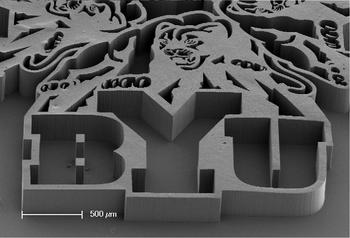
We study the physics of vertically aligned carbon nanotube forests: how they nucleate and grow from thin catalyst films, how coatings penetrate and infiltrate them, and how the resulting structures behave mechanically, electrically and optically. Patterning the catalyst lets us shape forests into tall three-dimensional microstructures, which makes them both a model system for these questions and a platform for new applications. Our current work focuses on the three areas below.
Neural Electrodes
Tall, free-standing carbon nanotube microelectrode arrays for interfacing with neural tissue. We measure the mechanical behavior of millimeter-tall arrays and have shown carbon nanotube electrodes whose magnetic susceptibility matches tissue, so they cause little distortion in MRI.
- Mechanical characterization of vertically aligned carbon nanotube forest microelectrodes for neural interfacing, Front. Neurosci. 20 (2026)
- Fabrication of High Aspect Ratio Millimeter-Tall Free-Standing Carbon Nanotube Based Microelectrode Arrays, ACS Biomater. Sci. Eng. 4, 1900 (2018)
- Tissue-susceptibility matched carbon nanotube electrodes for magnetic resonance imaging, J. Magn. Reson. 295, 72 (2018)
Field Emission
Patterned carbon nanotube arrays emit electrons under modest electric fields. We compare measured emission with the extended Murphy–Good model, study how array geometry affects emission in arrays that are grown, flipped and transferred, and investigate the mechanisms of nanotube growth directly on stainless steel.
- Field emission from flipped and patterned vertically aligned carbon nanotube arrays, Nanotechnology 36, 075703 (2024)
- Mechanisms for carbon nanotube growth on oxidized 316L stainless steel substrates, Appl. Surf. Sci. 710, 163993 (2025)
- Applying & Comparing the Extended Murphy Good Calculator to Patterned As-Grown Carbon Nanotube Field Emitters Adhered to Titanium., IEEE Int. Vacuum Electronics Conf. (2026)
Carbon Nanotube Optics
Carbon nanotube forests absorb nearly all the light that reaches them. We study how forest structure controls absorption and transmission, and use it to make parallel-hole collimators for visible and short-wave infrared light, mechanically robust ultra-black coatings, and windows that transmit extreme- and vacuum-ultraviolet light while limiting gas flow between vacuum chambers.
- Visible and short-wavelength infrared light collimation through carbon nanotube, parallel-hole collimators, Opt. Express 30, 22679 (2022)
- Mechanically Robust Vertically Aligned Carbon Nanotube Composites for Applications in Ultralow Reflectance Optical Elements, ACS Appl. Nano Mater. 5, 6989 (2022)
- Carbon nanotube collimator as an vacuum ultraviolet window, J. Vac. Sci. Technol. B 42, 043001 (2024)
- Carbon nanotube microfabricated window with extreme ultraviolet transmission and differential pumping, Proc. SPIE 12201 (2022)
Earlier Work
- Electrical conductivity across the alumina support layer following carbon nanotube growth, J. Vac. Sci. Technol. B 39, 052803 (2021)
- Penetration depth variation in atomic layer deposition on multiwalled carbon nanotube forests, J. Vac. Sci. Technol. A 37, 030907 (2019)
- Carbon monolith scaffolding for high volumetric capacity silicon Li-ion battery anodes, J. Vac. Sci. Technol. B 35, 041802 (2017)
- High-Aspect-Ratio Metal Microfabrication by Nickel Electroplating of Patterned Carbon Nanotube Forests, J. Microelectromech. Syst. 24, 1331 (2015)
- Mechanical Property Measurement of Carbon Infiltrated Carbon Nanotube Structures for Compliant Micromechanisms, J. Microelectromech. Syst. 23, 1330 (2014)
- Carbon-Nanotube-Templated Microfabrication of Porous Silicon-Carbon Materials with Application to Chemical Separations, Adv. Funct. Mater. 21, 1132 (2011)
Complete publication and student thesis lists for each professor are on the People and Publications page.